
North Brunswick Previous Residents by Era
Previous residents research follows a source ladder. A parcel record identifies the place, a deed records a land transaction, and a dated directory or census can supply a household clue. They should not be collapsed into one claim. The first task is to determine the period in question and use the repository that documents that era. For older North Brunswick addresses, also preserve the historical municipality label because today’s township boundary does not match every older record label.
| Source | Years It Covers | Where Held | What It Shows |
|---|---|---|---|
| Middlesex County deed index | 1929-present; county digitization notice reports deeds back to 1923 | Middlesex County Clerk Official Records Search and Registry | Indexed parties, dates, instrument details, book-page and property clues |
| Older Middlesex deed indexes | 1784-1922 | NJ State Archives and county historic-record routes | Grantor-grantee references and deed-book leads |
| Regional New Brunswick directories | Documented years from 1872-73 through listings for 1981 | Library databases, repository collections, directory indexes | Historical address, name, occupation, and possible reverse-section leads |
| Federal census | 1790-1950 public under the 72-year rule; library page specifies 1790-1930 HeritageQuest coverage | Library databases and National Archives partner services | Household and place snapshot on the census date |
| Brunswick newspapers | Forum, 1939-1942; Sentinel, 1995-2017 | Digifind-It and North Brunswick Public Library | Dated notices, obituaries, legal advertisements, and place events |
| Municipal permits | Start year not located | North Brunswick Building, SDL, or a bounded OPRA request | Work, site, permit, and inspection information where retained or released |
Begin with the current parcel and the most recent recorded conveyance when the address is known. Move to a library or archive route when the digital index ends. A permit, a newspaper item, or an assessment display can support the timing of a property event, but none alone proves who occupied the address.
North Brunswick Parcel Keys Before Deeds
Use the same parcel key across the assessment display, GIS map, and recorded-land index. The North Brunswick Tax Assessor maintains ownership and address information for tax administration, tax maps, and related assessment work. The county GIS layer can expose current or old block and lot, PAMS PIN, geometry, deed book or page, sale date, owner or mailing fields, ZIP, acreage, year built, and update information. Those fields are research leads, not proof of occupancy.
A situs address identifies the parcel location. A mailing address may be an owner, entity, agent, or tax contact, and can differ from the site. Save the municipality, block, lot, qualifier, PAMS PIN, and any old block or lot before changing from a map search to a deed search. Where fields conflict, note the conflict and ask the record custodian rather than silently selecting one.
Middlesex Deed Index for Previous Residents
The Middlesex County Official Records Search is the main online entry for the land-record trail. The Clerk reports practical online coverage for deeds from January 1, 1929, mortgages from 1950, and other documents from 1958. A county 2022 notice reports that deed digitization reached back to 1923. These are overlapping access notes, not a promise that every earlier North Brunswick document is imaged or searchable in the same way.
The official-records screen is the starting point for a dated instrument search, not a list of past residents.
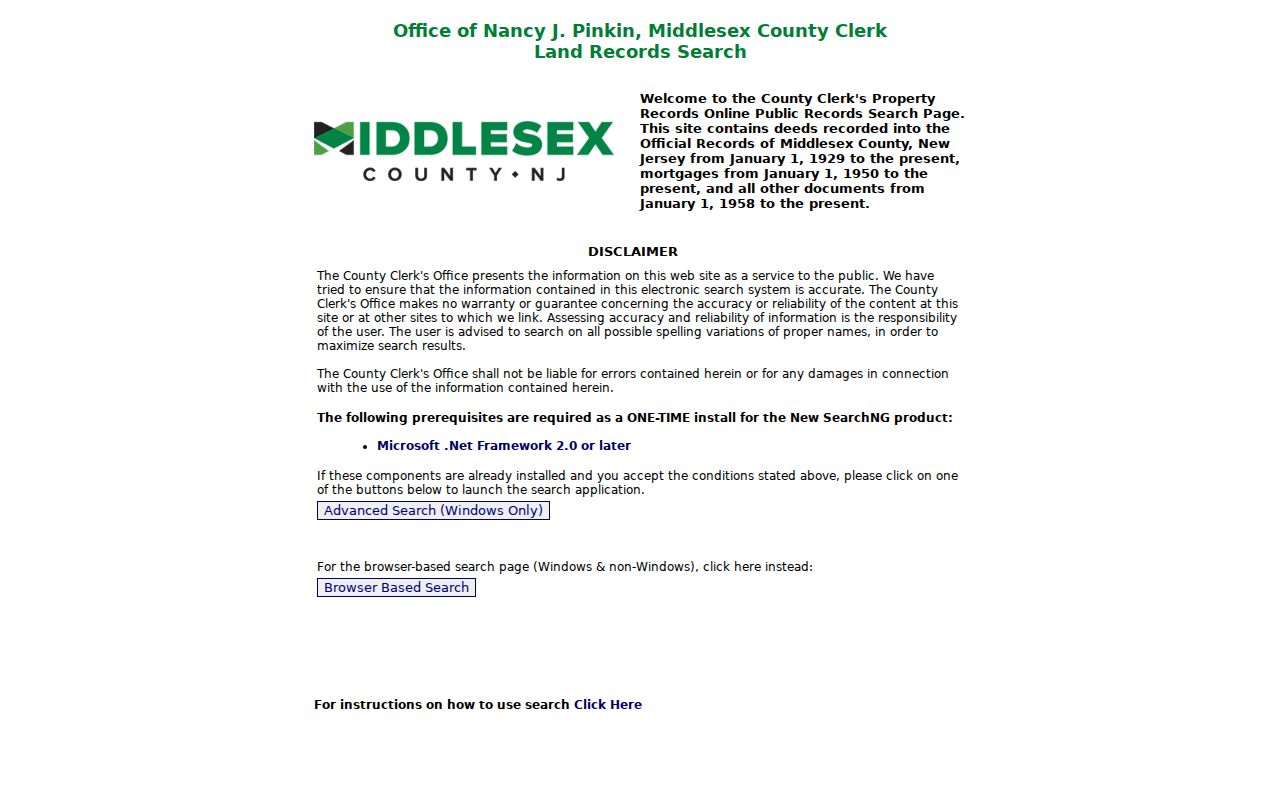
Use the browser-oriented Clerk search for party, property or legal description, book or page, instrument, and date modes. Capture party role, instrument type, execution and recording dates where shown, instrument number, book or page, municipality, and legal description. A mortgage, lien, release, or assignment is not a conveyance and should remain separately labeled.
Note: The Clerk's current fee schedule is the authority for copy charges, so confirm it before requesting a document.
Tracing North Brunswick Previous Residents in Deeds
A chain of title moves backward through conveyances, not through assumptions about a person. Start from the current parcel record, locate the most recent purchase deed, and then use the seller as the next historical lead. The research record calls this sequence current parcel, assessed owner or mailing field, most recent deed, grantor, then the earlier deed in which that grantor was grantee. Preserve the document roles and dates at every step.
- Find the North Brunswick parcel in the assessor or GIS source and record its legal identifiers.
- Search the Clerk index by property or legal fields, then test the most recent deed's parties.
- Read the seller as grantor and search that person as grantee for the earlier purchase.
- Repeat the dated sequence, logging document type, recording date, instrument number, book or page, and legal description.
- When online coverage stops, consult the Registry public room, NJ State Archives indexes or microfilm, FamilySearch county-deed material, and the Clerk's written-request route.
- Grantor
- The party transferring an interest in a recorded document. The role must be read from that document, not assumed from a name alone.
- Grantee
- The party receiving an interest. Searching a former grantor as grantee can identify an earlier acquisition.
- Chain of title
- A dated sequence of recorded land interests tied to the same parcel or legal description.
- Legal description
- The recorded parcel description. It often survives address changes better than a street label, but it still needs comparison with the map and record date.
North Brunswick Past Residents and Place Labels
The township's boundary story is a necessary part of an address history. North Brunswick began within Piscataway and was incorporated in 1779 as a 36-square-mile area that included all of New Brunswick and parts of Milltown and East Brunswick. The 1860 act left the modern township. An older deed, directory, census, or road survey may therefore use a label that seems wrong from a current map. Record that label, date, and source before making a modern cross-reference.
| 1779 | The historical North Brunswick incorporated area was much larger than the present township. |
|---|---|
| 1860 | The boundary change created the modern township footprint. |
| Old address work | Compare road surveys, tax maps, deed descriptions, directories, newspapers, and GIS old block or lot fields. |
| Unresolved street | Do not force an old description onto a modern parcel without a documented crosswalk. |
There is no verified North Brunswick-wide street renumbering or renaming year in the research. That gap matters. A careful history can say that a street connection is unresolved and still provide a useful next repository.
North Brunswick Previous Residents in Directories
Recorded owners are only one layer of a property history. A regional city directory, a reverse or criss-cross section where the volume actually includes one, and a census schedule can supply dated household clues. The North Brunswick Library's genealogy page links HeritageQuest for federal census material and directs readers to the Brunswick newspaper archive. The regional directory collections themselves are cataloged on the North Brunswick city directory page, where their New Brunswick labeling and access limits are explained.
Use a simple paired process: address or name in a dated directory, then the nearest available census year, then a land or newspaper record that fits the same place and period. A directory's first or last appearance can reflect a move, a spelling change, a missing year, a different jurisdiction, or an omitted listing. It does not state a reason.
Address history flow: parcel identifier → recorded deed sequence → dated directory or reverse section when present → census snapshot → newspaper or probate lead → source-date check.
Lawful use. North Brunswick previous-resident research is appropriate for family history, house history, estate questions, and civic curiosity. Do not use a historical lead to harass, track, or make claims about a living person.
North Brunswick Previous Residents in Newspapers
The Brunswick digitized newspaper archive supplies a different kind of dated evidence. It includes the Forum for 1939-1942 and the North & South Brunswick Sentinel for 1995-2017. Search an old road, organization, cemetery, farm, legal notice, event date, or obituary, then record the article date, page, and article type. An advertisement or contact line is not proof that a person lived at the address.
The archive interface is shown as a historical-search route for North Brunswick address and place research.
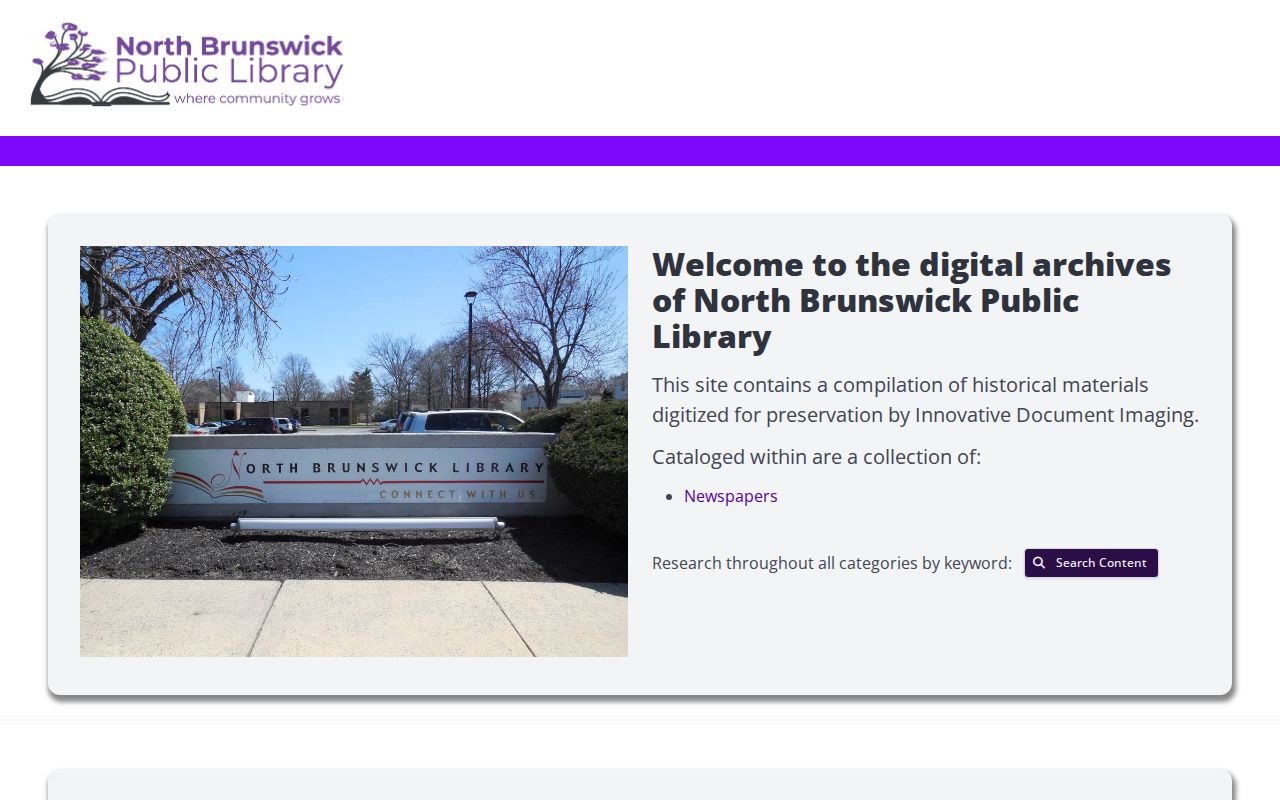
A newspaper lead should be checked against a deed, census, probate file, or another date-specific source. The Middlesex Surrogate's search can provide estate leads, while its Records Department handles copies and has its own access and fee rules. A role in a probate file does not by itself establish a household relationship or residence.
North Brunswick Records for Previous Residents
Municipal building records can date work at a property, but the research did not find a confirmed public permit-results interface or a start year for a dedicated local permit archive. The Building form documents fields such as block and lot, site address, permit number, work, subcode, plan, and inspection status. Use those fields to request a bounded address and date log through the Building office, SDL route, or the township's OPRA process.
The North Brunswick OPRA page identifies several delivery methods and advises requesters to identify an existing record. A useful request names the department, record type, date range, address, block or lot, and any permit number. Ask for a final inspection record, permit application, or dated log, not a new analysis. Protected information can be redacted, and a permit is evidence of work rather than proof of occupancy.
Note: The County Archives stores inactive records but directs researchers first to the originating office that retains ownership of the record.
North Brunswick House History at Pulda Farm
Pulda Farm offers a public-history model for tracing a place without turning it into a private household record. The township identifies it as the last remaining farm and states that it was acquired in 2010. The community-garden material identifies its current location as 300 Old Georges Road. The Historical Society's preservation work centers on the John Buckelew House there, described as possibly the township's oldest surviving structure.
For a comparable historic-place question, search grants, park records, maps, preservation material, newspapers, and land documents in date order. The strongest conclusion is the one the record supports: a property event, a place label, a public program, or a recorded transfer. Never extend that conclusion into an undocumented list of past residents.