
North Brunswick City Directory Collections
North Brunswick has no verified standalone printed-directory shelf or catalog in the public sources reviewed. The usable starting point is instead a set of regional New Brunswick city directories, plus library databases and local newspapers. That distinction matters. A regional volume can supply a lead for the North Brunswick area, especially before modern boundaries settled, but its place label and street context must remain attached to every note. Library staff can help determine whether a licensed database or a physical volume contains the needed year.
| Collection | Years | Where Held | Access |
|---|---|---|---|
| New Brunswick regional directory index | 1872-73, 1874-75, 1886, 1890, 1897, 1899, 1901, 1903 | Established directory index, with listed Ancestry availability | Confirm database access and the volume's place label |
| New Brunswick regional run | 1901-1933 | Allen County Public Library | Repository lead; confirm the needed volume |
| New Brunswick regional guide listings | Multiple years through 1960; 1962-1981 | MyHeritage listings and a New Jersey directory guide | Verify year and access with the provider |
| Brunswick digitized newspapers | Forum, 1939-1942; North & South Brunswick Sentinel, 1995-2017 | Digifind-It and North Brunswick Public Library | Keyword search and library reference help |
The runs have gaps. The Gale author and reel index notes several missing New Brunswick years between 1886/87 and 1928/29. No source reviewed established a first or last printed North Brunswick directory, a particular publisher, or a reverse section for every year. Record the exact volume, publication year, page, and place wording instead of filling gaps with assumptions.
North Brunswick City Directory Research
The North Brunswick Public Library genealogy resources provide the strongest local starting point for city directory research. The library is at 880 Hermann Road and lists a reference desk at 732-246-3545 and refdesk@northbrunswicklibrary.org. Its genealogy page links Ancestry Library, HeritageQuest, and the Brunswick newspaper archive. Those sources can connect a dated directory finding to census, land, probate, church, court, military, or local-history material without treating any one result as final proof.
The library genealogy resource is shown here as a local route into historical databases and reference assistance.
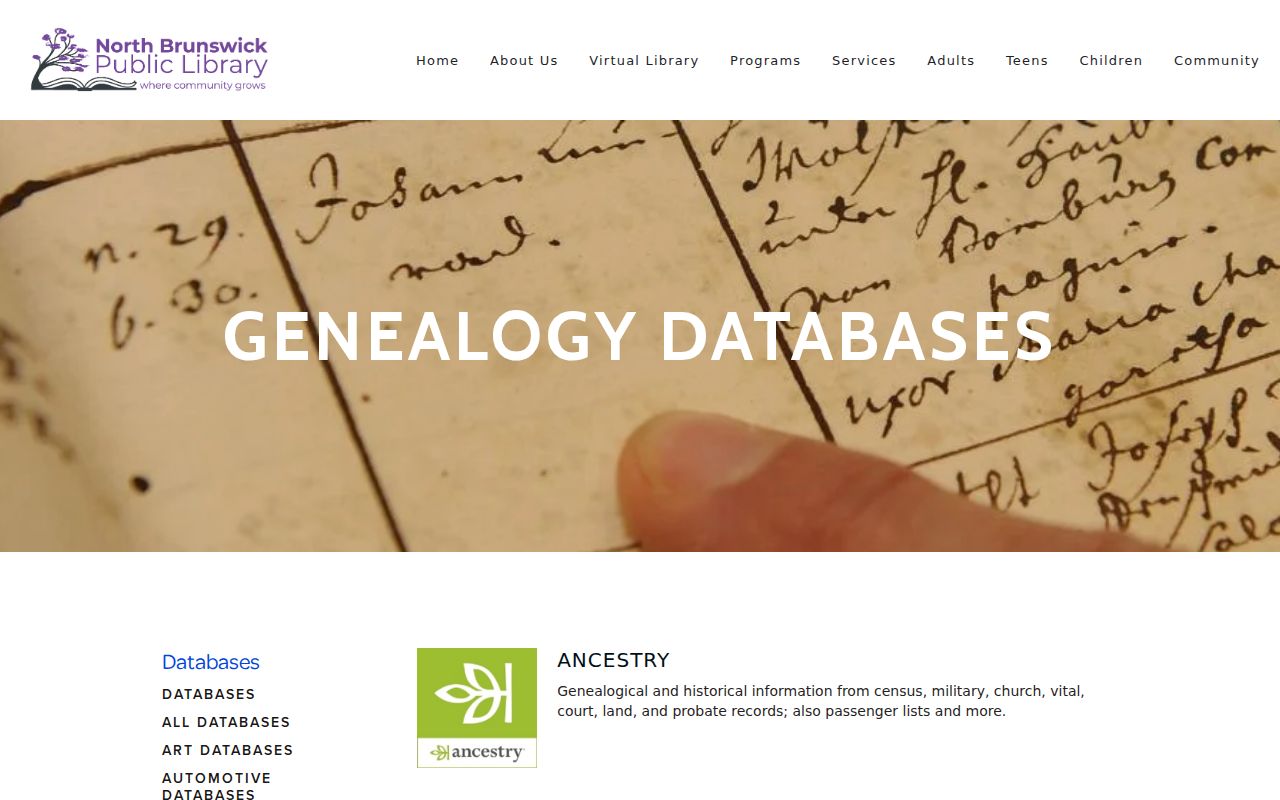
Ask whether a result comes from a regional New Brunswick directory, a newspaper database, or a separate collection. The public pages do not verify a complete North Brunswick telephone-book, yearbook, obituary-index, or directory shelf list. That is a reason to ask a focused reference question, not a reason to assume a collection exists.
Note: Licensed databases may require library access, and the reference desk can confirm the title, date, and source of a historical result.
North Brunswick City Directory Regional Labels
The New Brunswick city-directory index is useful precisely because it identifies regional material without pretending it is a modern township list. North Brunswick began as a much larger township in 1779, including all of New Brunswick and parts of Milltown and East Brunswick. An 1860 act created the current, much smaller township. Older record labels can therefore look unfamiliar while still being geographically relevant to a careful search.
The directory index image documents the regional year list that should be checked before drawing a conclusion about North Brunswick coverage.
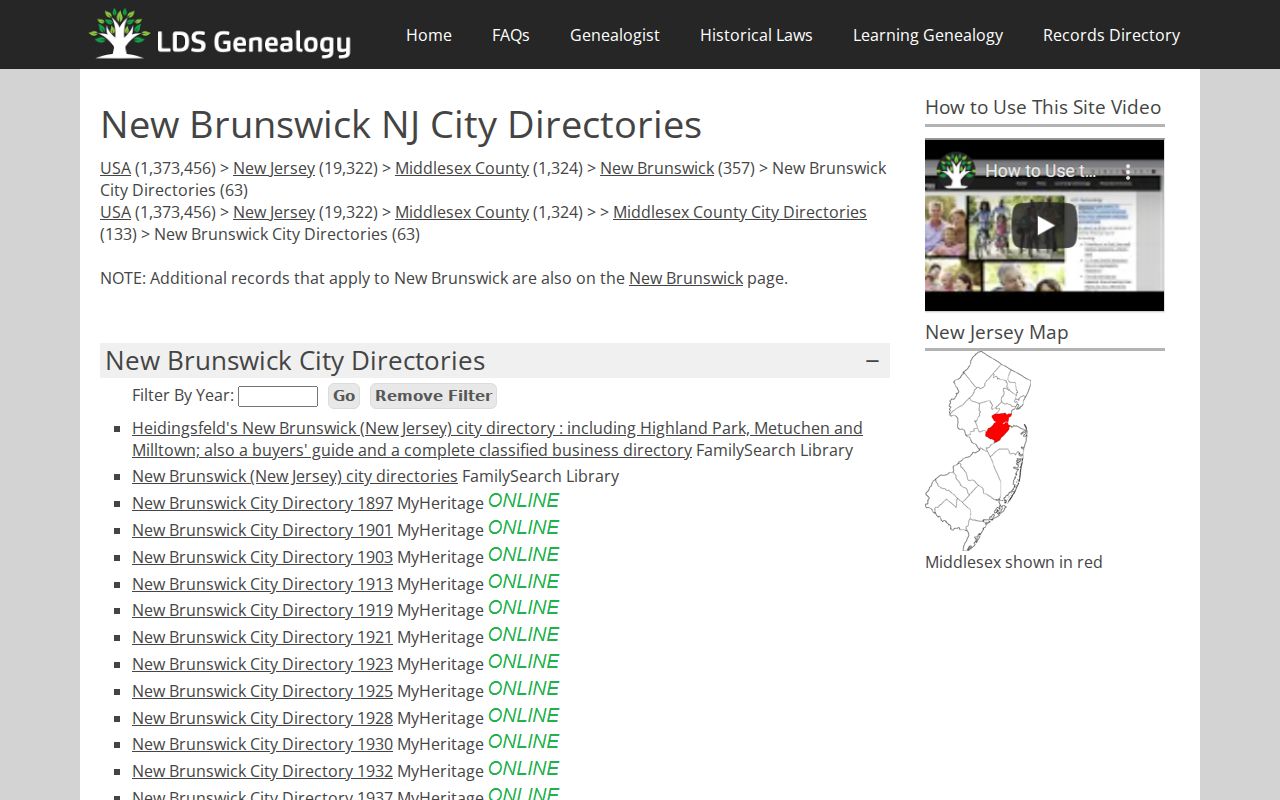
Use the source's own city or township name in a research log. Compare it with a street, a deed legal description, a census place label, or a road survey. A New Brunswick heading alone does not establish that every listed person or address was in modern North Brunswick.
Reading a North Brunswick City Directory Entry
A city directory entry is a dated publication record, not a current profile. Typical regional entries can include a name, spouse or widow notation, occupation or business detail, a street address, and marks such as h or r. The research did not yield an inspectable page image for a New Brunswick entry, so exact abbreviations and page layout should be checked in the relevant volume before they are transcribed. Preserve punctuation, initials, and the printed street name.
| Name | Copy the name as printed, including initials and spelling variants. |
|---|---|
| Spouse or widow notation | A period clue that should be checked against another dated source. |
| Occupation or business | Context from that publication year, not proof of a later role or address. |
| Street address | The printed location, which may use a historic place or street label. |
| Owner or renter mark | Use only if the volume's own abbreviation key defines the mark. |
- Criss-cross directory
- A directory section arranged by street and address rather than by surname, when a specific volume includes one.
- Householder index
- An alphabetical listing that usually identifies the person printed for a household address; its coverage depends on the volume.
- Abbreviation key
- The publisher's legend for shorthand, usually near the front of a volume. Photograph or cite it before expanding a mark.
North Brunswick City Directory Place Changes
Place vocabulary is the hard part of historical city directory work here. North Brunswick was first within Piscataway. The Historical Society dates the first permanent settlement to 1761, incorporation to 1779, and the boundary change that produced the modern township to 1860. A directory, deed, road survey, or census can use North Brunswick, New Brunswick, Piscataway, Milltown, East Brunswick, or a rural description. Treat that variation as a search path, never as evidence that a household moved.
| 1761 | Historical Society account dates the first permanent settlement. |
|---|---|
| 1779 | Freeholders incorporated a 36-square-mile North Brunswick that included a broader area. |
| 1860 | An act separated other communities and left the modern township area. |
| 1982 | The township adopted a mayor-council-administrator form of government. |
For an old street, compare road surveys, deed descriptions, tax maps, newspaper notices, directory labels, and GIS old block or lot fields. No North Brunswick-wide renumbering or street-renaming year was verified. An unresolved old address should stay unresolved until a record supplies the crosswalk.
North Brunswick Historical Society Context
The North Brunswick Historical Society provides the local boundary history needed to interpret city directories. Its public mission centers on preserving the John Buckelew House at Pulda Farm, described as possibly the township's oldest surviving structure. The society's page does not publish a detailed holdings list, a stable research schedule, or a fee schedule. Contact it before planning a visit or relying on the existence of member papers, house files, or directory scans.
The Historical Society source image provides a reminder that North Brunswick's record geography changed over time.
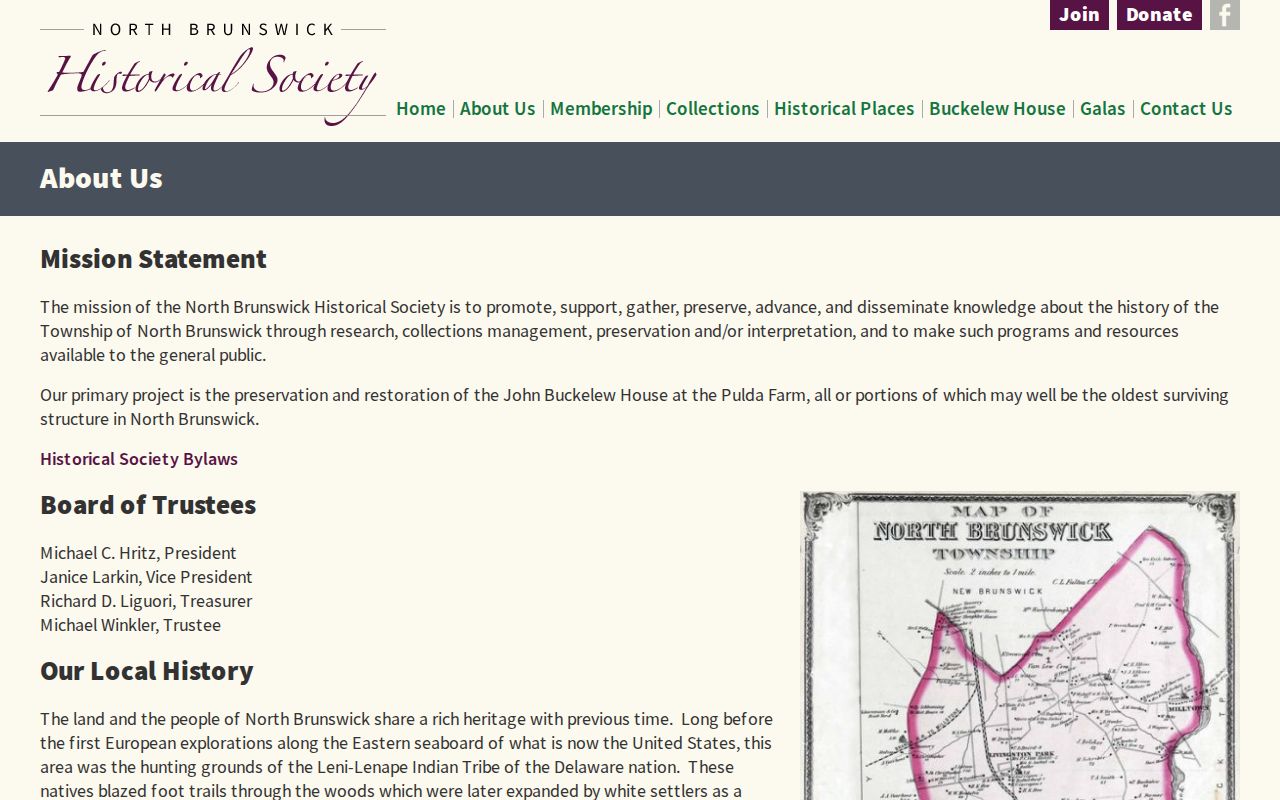
Pulda Farm was identified by the township as the last remaining farm and was acquired in 2010. Its public-history value is a lead to grants, maps, preservation material, and newspapers. It is not a basis for identifying a present household or descendants.
Elmwood's North Brunswick Family History Lead
Elmwood Cemetery is a useful human-history lead when a city directory or newspaper supplies a dated name and place. A township story states that the cemetery was established in 1868 and describes walking tours tied to Civil War, Spanish-American War, World War I, World War II, and Korean War service. It also notes a six-generation family connection. Those facts can point a researcher toward memorial, cemetery, veterans-grave, or archival material, while keeping the work anchored in historical evidence.
The County Clerk is reported to hold Civil War records and veterans' grave-report reels. Ask the Clerk or Archives about access and copying rules, and use only the historical details needed to verify a record. A cemetery reference is not a present-day family directory.
North Brunswick Archive Routes
When a city directory lead predates the accessible regional run, move from the library to the repositories that hold the deeper Middlesex record trail. The New Jersey State Archives reports public research access, appointment and walk-in guidance, copy fees, more than one million searchable records, and extensive paper and microfilm holdings. Its collections include county deeds, deed indexes, wills, surrogate material, vital records, and other historical sources. Some county deeds have also been digitized through FamilySearch.
Rutgers supplies a separate Middlesex finding aid with early court-book copies, marriage records and indexes, public-road surveys, deeds and conveyances, election returns, and other county material. The County Archives stores inactive records but says that those records remain the originating office's property. Start with the office that created the record, then use the archive or finding aid when a directory clue points to an older date or a changed place label.
Tracing North Brunswick City Directories
City directories work best as a sequence of dated snapshots. Begin with the nearest known year and keep the entry's source title, place label, page, and spelling. Then use a census or a land record to test whether the person-place connection holds at that date. The publicly available federal census is historical, with access governed by the 72-year release rule. The North Brunswick Library lists HeritageQuest coverage for federal census years 1790-1930, while other databases may have different access.
- Locate the surname and variants in one identified regional directory volume.
- Record the printed address, place label, page, abbreviations, and publication year.
- Check the next available directory year rather than assuming an annual run exists.
- Pair the dated entry with the nearest accessible census or a recorded land document.
- Use the Sentinel or Forum for a dated notice, obituary, organization, or street reference, then verify it in the underlying record.
A name disappearing from a city directory can mean many things: a move, a changed spelling, a publication gap, a different jurisdiction, or no listing. It does not identify a cause by itself. Where a historical entry needs a separate, current official record check, use the North Brunswick resident lookup route rather than treating the directory as current evidence.
Note: Keep the publication date beside every city-directory finding so a historical household lead is never presented as a current fact.